

Measure Before You Market: Why Restaurants Should Measure Existing Demand Before Paying for More
Measure What Happens to Existing Local Demand
Before Paying to Create More
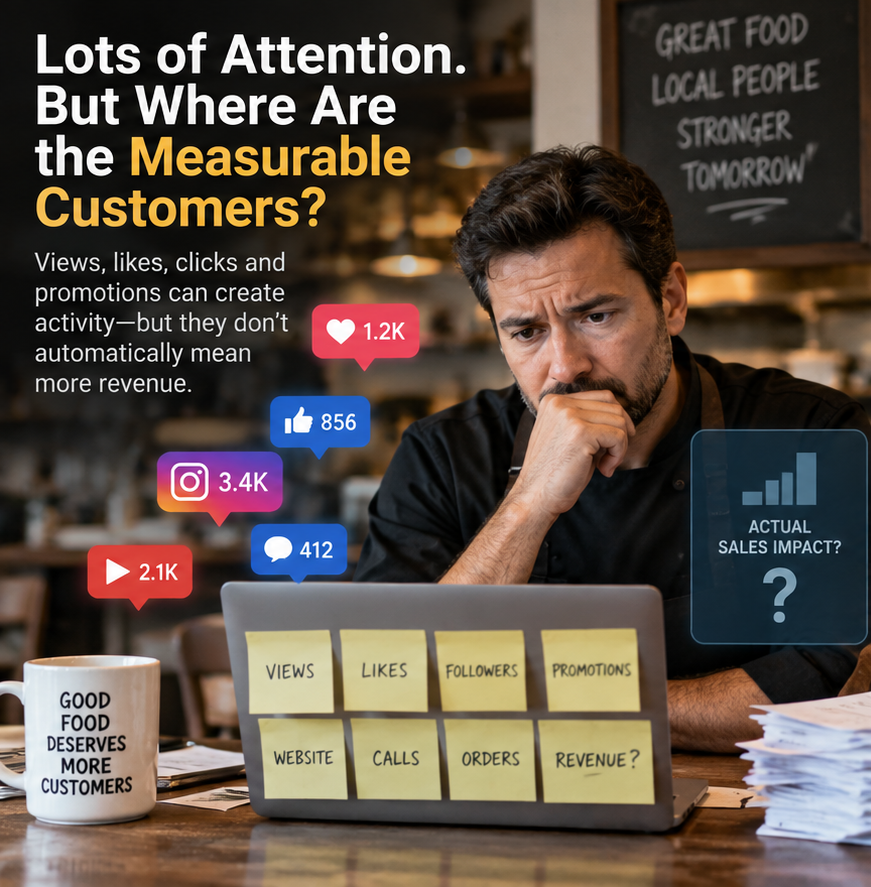
Independent restaurant owners are constantly being told they need more.
- More social media.
- More followers.
- More reviews.
- More advertising.
- More online orders.
- More technology.
- More customers.
But there is a question that should come before spending more money to generate additional attention:
What happens to the local demand your restaurant already has?
A customer searches for a restaurant nearby.
Someone sees a dish on Instagram.
A family reads your Google reviews.
A regular tries to call.
A potential customer visits your website. Someone clicks an ordering link.
A first-time guest walks through the door. Each represents existing customer interest.
But interest isn't the same thing as a measurable customer relationship—and attention isn't automatically revenue. At Local Restaurant Growth, this leads to a simple operating principle:
We don't create demand until we can measure what happens to it.
That doesn't mean restaurants should stop advertising, posting on social media, working with local creators, improving their reviews, or attracting new customers.
It means restaurant owners should understand what happens after the attention arrives.
The Restaurant Industry Doesn't Have Much Room for Unmeasured Growth
This matters because restaurants are operating in an increasingly unforgiving economic environment.
The National Restaurant Association reported in July 2026 that total restaurant expenses had increased 36% compared with pre-pandemic levels. The association says elevated costs continue to pressure margins and make efficiency and productivity increasingly important.
Meanwhile, the association's 2026 industry outlook describes restaurant traffic as uneven while consumers—particularly lower- and middle-income households—remain under financial pressure.
For an independent restaurant, that changes the growth conversation.
When margins are under pressure, “let's spend more money getting attention” cannot be the only answer.
Before adding more demand, it makes sense to determine whether the restaurant is effectively capturing the demand already reaching it.
Attention Is Valuable. But Attention Is Not the Final Outcome.
Social media is a good example.
There's compelling evidence that social media influences where people eat.
DoorDash's 2025 consumer research found that Instagram, Facebook, TikTok and YouTube were all being used to discover restaurants.
The same research found that 56% of surveyed Americans had ordered a trending restaurant item for delivery after seeing it on social media.
That's important.
But consider what the restaurant owner actually sees.
A video receives 20,000 views.
A creator's post gets hundreds of likes.
The restaurant gains followers.
People share a photo.
Those numbers tell the owner something about attention.
They don't necessarily answer:
How many people ordered?
How many were new customers?
How many became identifiable customers the restaurant could appropriately reach again?
How many returned?
What did those customers spend over time?
Was the activity profitable?
That doesn't make views or engagement meaningless.
It means they're measuring a different part of the customer journey.
The mistake is treating an attention metric as a business outcome.
A Restaurant Can Be Busy and Still Have a Measurement Gap
Imagine a restaurant owner looking at five different reports.
Instagram says the restaurant reached thousands of people.
Google shows searches, calls and website visits.
The online ordering system shows orders.
The POS shows transactions.
A loyalty system shows members.
Every system contains useful information.
But the owner may still struggle to answer a surprisingly basic question:
What happened to the customer?
Did someone discover the restaurant and disappear?
Did they look at the menu and choose somewhere else?
Did they order?
Was the order direct or through another channel?
Did the restaurant learn who that customer was?
Did that customer ever return?
When those steps aren't connected, the restaurant doesn't necessarily have a marketing problem.
It may have a measurement problem.
And buying more attention doesn't automatically fix it.
The Five Stages of Measurable Local Restaurant Growth
Local Restaurant Growth looks at the customer journey through five practical stages:
1. FIND
Can local customers find the restaurant when they're deciding where to eat?
Discovery can happen through search, maps, reviews, social media, recommendations, local creators, marketplaces and other channels.
The first question isn't simply how many people saw the restaurant.
It's whether the restaurant is visible when relevant local demand exists.
2. CHOOSE
When customers find the restaurant, do they have enough reason to choose it?
Discovery does not guarantee selection.
Customers may compare:
Reviews.
Photos.
Menu information.
Prices.
Location.
Hours.
Recent customer experiences.
Social content.
Ordering options.
The restaurant can generate plenty of visibility while losing potential customers during this decision stage.
That is why increasing reach without understanding conversion can hide an existing problem.
3. ORDER
Once someone decides to buy, how easy is it to complete the transaction?
A customer shouldn't have to fight the restaurant to become a customer.
Broken links.
Confusing menus.
Unanswered calls.
Poor mobile experiences.
Missing information.
Unclear ordering options.
Each can create friction between customer intent and an actual transaction.
Before paying for another click, restaurant owners should know whether the clicks they're already receiving have a clear path to an order.
4. BECOME KNOWN
This may be one of the most overlooked stages.
A transaction and a known customer are not necessarily the same thing.
A restaurant can process hundreds of transactions while knowing relatively little about the people behind them.
That matters because the value of a customer relationship doesn't necessarily end when the check closes.
Recent Toast and Resy research illustrates just how important repeat guests can be.
Toast's Q1 2026 platform data suggests that, within the cohort analyzed, as much as 50% of restaurant order volume could come from only 7% of guests.
That does not mean 7% of customers generate half the business at every restaurant.
It does show why understanding repeat behavior deserves serious attention.
If repeat customers can represent an outsized portion of restaurant activity, identifying and appropriately recognizing customer relationships becomes more than a marketing exercise.
It becomes a business question.
5. RETURN
The final question is the one restaurant marketing often skips:
Did the customer come back?
Not:
Did they open the email?
Did they like the post?
Did they redeem a coupon?
Did they click?
Those can all be useful signals.
But the business outcome is different.
Did customer behavior actually change?
A coupon redemption by itself, for example, doesn't prove incremental sales.
The customer might have purchased anyway.
Likewise, a loyalty enrollment doesn't automatically prove loyalty.
Restaurant owners need to distinguish between marketing activity and customer behavior.
The goal isn't simply getting someone into a database.
The goal is understanding whether customers return—and whether those relationships contribute profitably to the business.
Why Known Customers Matter
Restaurants have always understood regulars.
The difference today is that technology can potentially help restaurants recognize patterns that once lived almost entirely in the owner's or server's memory.
Toast and Resy's 2026 research found that 48% of surveyed guests said being remembered makes them feel most valued, yet only 30% said they always receive that level of recognition.
That's an interesting gap.
But technology shouldn't replace the hospitality that makes a regular feel like a regular.
It should help the restaurant support it.
A useful customer system should help employees understand the guest better.
A useful ordering system should make buying easier.
A useful measurement system should help an owner understand what is working.
The objective isn't collecting more technology.
It's creating a better connection between customer activity and business outcomes.
More Restaurant Technology Isn't Automatically the Answer
Independent restaurants already have plenty of technology choices.
POS systems.
Online ordering.
Reservations.
Delivery marketplaces.
Loyalty programs.
Email.
Text messaging.
Review platforms.
Social media.
AI tools.
Analytics.
The temptation is to assume that another piece of technology will connect everything.
But recent independent restaurant research suggests a more nuanced picture.
The James Beard Foundation's 2026 Independent Restaurant Industry Report, produced with Deloitte, found that restaurants with moderate, intentional technology adoption reported stronger business performance than businesses at either the low- or high-technology extremes.
The Foundation also describes owners and operators as overwhelmed by an environment of more tools, more platforms and more decisions.
That supports an important distinction:
The goal isn't more restaurant technology.
The goal is technology that helps solve a clearly identified business problem.
Before adding another system, ask:
What problem are we trying to fix?
What customer behavior should change?
How will we measure that change?
What happens if the new system doesn't connect with the information we already have?
If those questions don't have clear answers, adding another tool may simply add another dashboard.
Find the Leak Before Turning Up the Faucet
Think about restaurant demand like water moving through a pipe.
Marketing puts more water into the system.
But what happens if the pipe leaks?
Customers find the restaurant but don't choose it.
Customers choose it but can't easily order.
Customers order but remain anonymous.
Customers visit once but never receive a meaningful reason to return.
The restaurant can keep pouring more demand into the top.
But growing a leaky system can also grow the leak.
That's why the first growth question shouldn't always be:
“How do we get more customers?”
Sometimes the better questions are:
Where are customers already finding us?
Where are we losing them?
Which activity can we connect to actual transactions?
How many transactions can we connect to known customers?
Which customers come back?
What happens differently when they do?
Those questions lead to a very different growth strategy.
Measure First. Then Decide Where More Demand Makes Sense.
None of this is an argument against restaurant marketing.
Quite the opposite.
Better measurement can make marketing more useful.
Once a restaurant understands its existing customer journey, the owner can make more informed decisions about where additional demand may be valuable.
Maybe the restaurant does need more local search visibility.
Maybe its reviews are preventing consideration.
Maybe a local creator could introduce the restaurant to the right audience.
Maybe direct ordering needs improvement.
Maybe the restaurant has plenty of first-time customers but weak repeat behavior.
Maybe existing customers simply aren't being recognized.
Those are different problems.
They shouldn't automatically receive the same solution.
Find the business gap first.
Then determine what deserves investment.
The Local Restaurant Growth Principle
The Local Restaurant Growth approach can be summarized in five stages:
Find → Choose → Order → Become Known → Return
The objective is not simply to generate more attention.
It is to help independent restaurants build systems that allow more local demand to become known customers who return profitably.
That requires connecting discovery, reputation, ordering, customer information, repeat visits and transaction measurement instead of treating each as a separate marketing activity.
And it begins with one principle:
We don't create demand until we can measure what happens to it.
Before buying more attention, understand the attention you already have.
Before adding another tool, identify the business problem it needs to solve.
Before calling a campaign successful, determine what customer behavior actually changed.
And before constantly paying to find the next customer, understand what happened to the customer you already earned.
Start With Your Restaurant's Existing Demand
A useful first step is to map your restaurant's current customer journey:
Find. Choose. Order. Become Known. Return.
Then ask where measurement disappears.
Where does the restaurant lose visibility into what customers do next?
Where does customer intent encounter unnecessary friction?
Where does a transaction remain anonymous?
Where does a first visit fail to become a second?
Those gaps can tell you something another thousand impressions cannot.
Measure what happens first. Then decide where more demand deserves your money.